
With this guide, we aim to provide an introductory overview of the most common basic concepts and processes that a person may encounter.
This guide is in no way a substitute for professional advice, as an in-depth study of different personal circumstances is required in order to provide the best and most beneficial advice.
Please do not hesitate to get in contact with us and we will be glad to provide you with the best solution for your situation.
The real estate market in Spain is cyclical and highly dynamic, with a high percentage of home ownership among residents (close to 80%). Since 2016, prices have shown constant growth, although factors such as inflation and the rise of the Euribor have influenced the recent market, leading many buyers to opt for resale housing.
The foreign buyer plays a crucial role, with non-residents often paying an average price per square meter higher than that of residents, which underscores a strong investment and second home interest.
Although the purchase decision is personal, the seasonality can influence availability and negotiation:

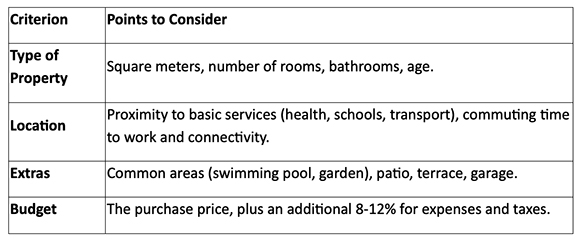
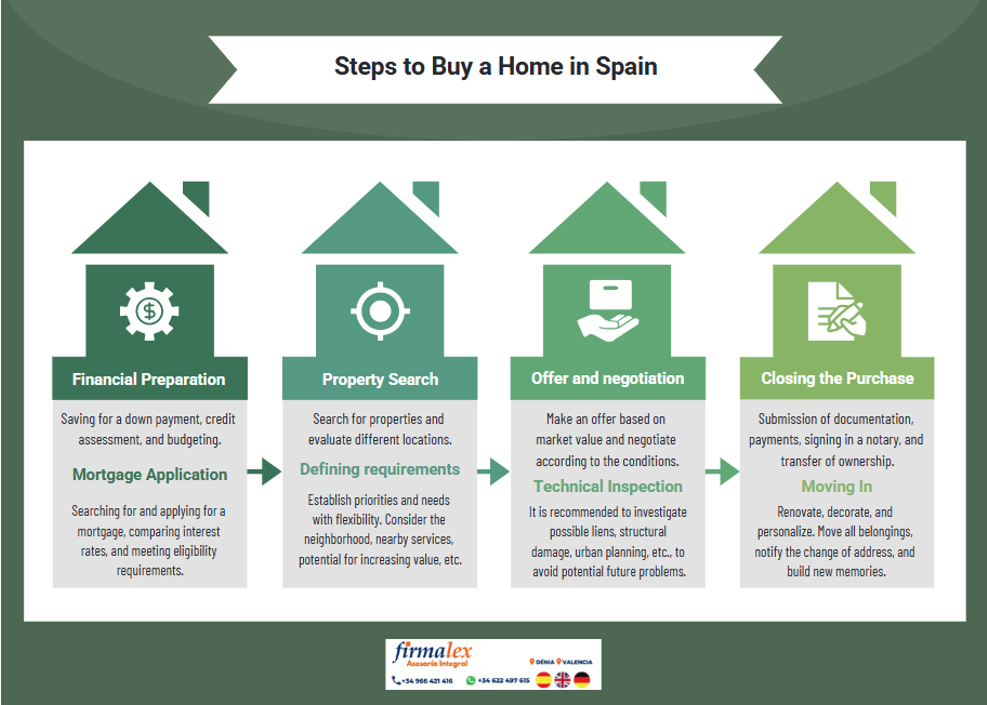
At Firmalex, before starting the search, we recommend establishing the requirements that the property must meet.
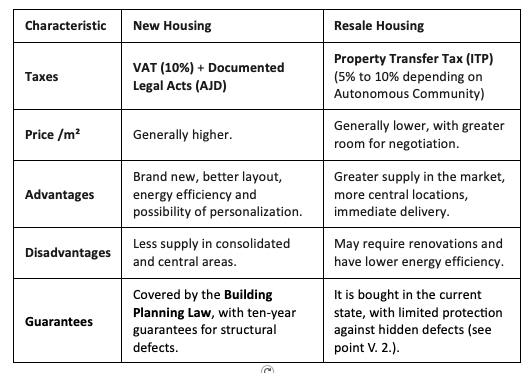
The choice between a brand new or pre-owned home impacts the cost, taxes, and property conditions.
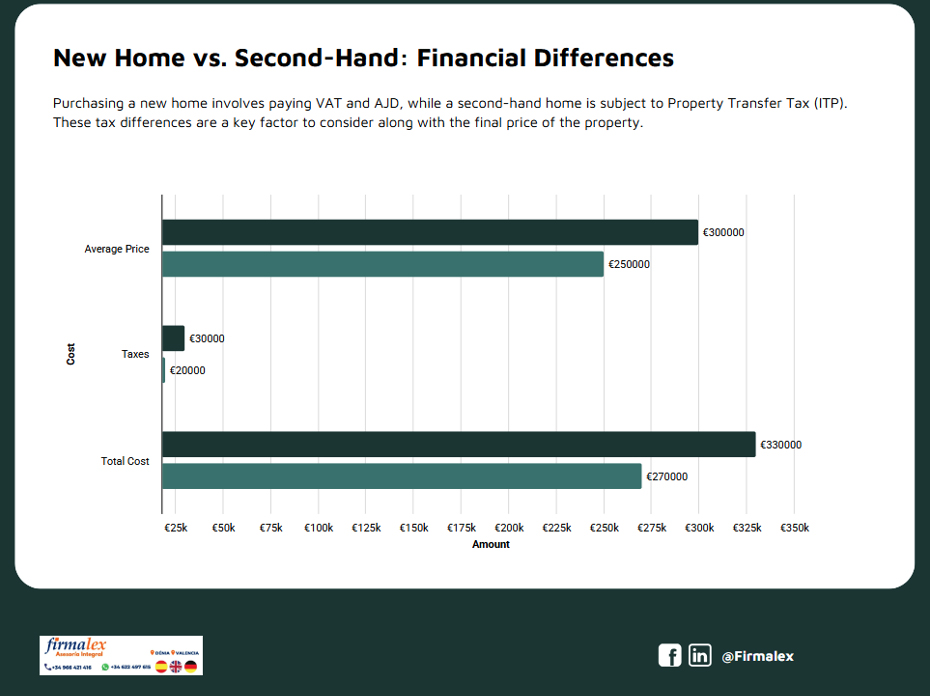
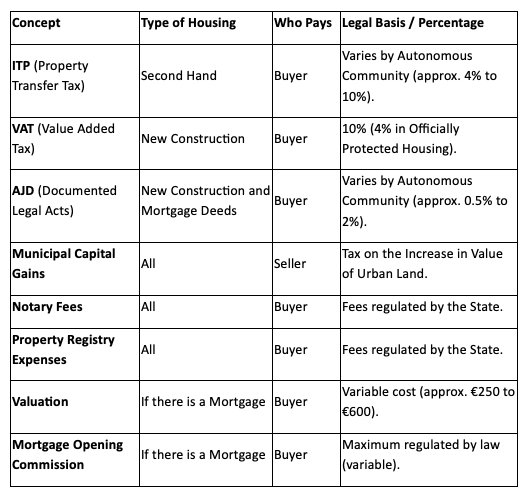
The cost of housing goes beyond the sale price. You must have a minimum of 10% to 15% additional of the purchase price to cover the following expenses and taxes:
For any foreign or non-resident buyer, the requirements are simple, but mandatory:

Spain offers a visa program for non-EU citizens: if the real estate investment exceeds 500.000 €, the buyer can apply for a residence visa (Golden Visa).
Online real estate portals such as Idealista or Fotocasa are the main tool for searching. If the goal is investment for rent, the highest returns (annual gross rents between 6% and almost 9%) are usually found outside the major capitals (Madrid or Barcelona), with cities such as being more profitable Lleida, Murcia, Huelva, Santa Cruz de Tenerife or Almería.
Buying without a real estate agency allows you to save the commission (which is usually paid by the seller, but may influence the final price) and negotiate directly. However, it obliges the buyer to assume all the bureaucratic and legal burden.
The hiring of a real estate lawyer collegiate in Spain is not mandatory, but it is highly advisable for preventive purposes.
The cost savings of hiring a real estate lawyer such as Jens Gerl or Agustín Costa far outweighs their fees, as it prevents legal and tax problems.
The lawyer is essential for preventive investigation and analysis (Due Diligence), the review of the tax situation (charges, vices and taxes) and the verification that the purchase contracts are in order.
In addition, it is beneficial for non-residents because pcan act with a power of attorney on behalf of the buyer if he/she is not present in Spain for the procedures.

Before signing any deposit or reservation contract, it is mandatory to carry out a thorough verification of the property.
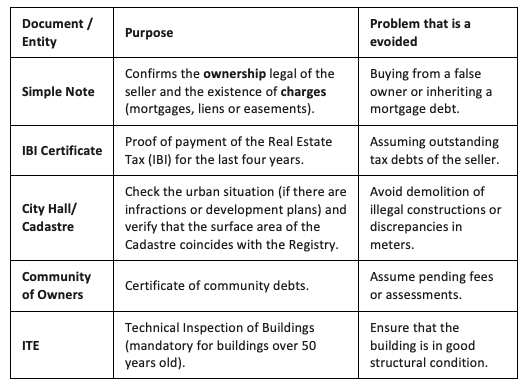
The personal visit is essential. In addition, the seller is responsible for the hidden defects– serious defects that were not evident in the purchase. Although the seller is responsible, the claim can be difficult, so it is recommended to commission an independent expert report (survey) to a technician (quantity surveyor or architect) before paying the deposit or signing the deposit contract. If it is not possible, the contract must include a clause that allows the buyer to withdraw without penalty if structural or serious defects are detected.
The hidden defects are defined in the article 1484 of the Civil Code such as those defects in the property that, had the buyer known about them, they would not have acquired it or would have offered a lower price.
If you need a loan, you should have discussed your needs with the bank before paying the deposit, as the appraised value may differ from the market price.
Mortgage Relief Mechanisms (Codes of Good Practice)
Financial institutions, often in collaboration with the Government, implement Codes of Good Practice and other mortgage relief measures in contexts of economic instability or significant variations in interest rates.
Steps The purchase is formalized before a Public Notary through the signing of the Sale Deed. It is the moment in which the total price is paid (by bank check) and the property is transferred with the delivery of keys.
Post-Signature Steps:
The average time from the start of the search to signing at the notary is 3 to 6 months. This period may be extended if the property requires renovations or if the mortgage processing is delayed.
The buyer is responsible for most of the expenses, which range between 8% and 12% of the purchase price.
Unknown legal charges (mortgages, liens, usufructs). It is advisable to request an updated Simple Note and review it carefully to verify owners, charges and limitations.
Appraisal value lower than the purchase price. It is recommended to carry out an independent prior appraisal before signing a deposit agreement, or negotiate the price based on the appraisal.
Hidden or miscalculated costs. It is important to make a complete calculation of the total cost, including ITP/VAT, notary, registry, management, appraisal and possible spills.
Delays or problems in new construction homes. It is advisable to review the purchase agreement, the deadlines, the penalties and the quality report. Verify the solvency of the promoter.
Hidden defects in second-hand homes. RWe recommend carrying out a professional technical inspection (architect or technician) before closing the purchase and document any defects.
Difficulties in obtaining financing. It is interesting to ccompare mortgage offers in several banks, improve financial documentation and review conditions such as ties and commissions.
Ambiguous contractual clauses or penalties. It is important to draft and review the deposit contractcarefully, including clear conditions (especially on financing).
Unexpected problems in the area or neighborhood. We always recommend analyzing the environment at different times, review transportation, noise, services, shops and security.
Hasty decisions due to commercial pressure. TAlso it is important to take the necessary time, do not hand over money without a contract and review carefully all documentation before committing.
Buying a home in Spain is a process that combines opportunities and challenges, especially in a dynamic market, influenced by economic, fiscal, and urban factors. The key to a safe and efficient purchase lies in planning, accurate information and diligence in each step. From clearly defining needs and budget to conducting thorough due diligence, each phase requires attention and rigor.
The choice between new construction and resale housing, the management of procedures such as the NIE or the mortgage, and the legal review by qualified professionals are decisions that directly influence the success of the operation. Likewise, understanding the tax burden, correctly analyzing the area, and anticipating possible problems—such as hidden defects, registration charges, or urban discrepancies—allows avoiding costly risks for both residents and foreign buyers.
In an environment where competition can vary depending on seasonality and where financing largely depends on solvency and appraisal, the informed buyer acquires a significant advantage. Having adequate advice, taking the necessary time, and reviewing each document with precision not only offers peace of mind but also a solid foundation to protect the investment in the long term.
In short, buying a home in Spain is not just a financial operation: it is a strategic decision that affects assets and quality of life. With adequate preparation, rigorous analysis, and the support of competent professionals like those at Firmalex, the process becomes safer, more transparent, and success-oriented.
The information in this guide has been synthesized and integrated from the following articles published by Firmalex:
FIRMALEX is your trusted consultancy in Dénia and Valencia. We offer a comprehensive professional service and a Comprehensive Real Estate Advice for the sale and purchase of real estate in Spanish territory.
Our staff speaks perfectly Spanish, Valencian, English and German, which allows you to communicate with us in your own language and resolve your queries clearly.
Offices:
Contact: